MENU

Proposed Trust Deed Amendments, Special Resolutions and Special General Meeting
Te Rūnanga Nui o Te Aupōuri (the Rūnanga) was first established in January 2011. The Rūnanga is the post settlement governance entity, or PSGE and the mandated iwi organisation, or MIO, for Te Aupōuri. This means that is holds both the fisheries settlement assets (under the Māori Fisheries Act 2004 (MFA)) and assets received under the Treaty of Waitangi Settlement, pursuant to the Te Aupouri Claims Settlement Act 2015 on behalf of Te Aupōuri.
Currently, the Rūnanga has a model where trustees act ‘personally’. It was recommended from a legal perspective to transition to a corporate trustee for a number of reasons including to mitigate exposure for trustees (now and in the future) while at the same time maintaining accountability of trustees, together with practical reasons (i.e. holding land and assets). It is recommended that the current custodian trustee, which already owns assets on behalf of Te Aupōuri, convert to a corporate trustee. This will save establishment costs and eliminate the need for an extra entity.
The Special Resolution is as follows:
The Adult Registered Members of Te Rūnanga Nui o Te Aupōuri agree to the amendments relating to the corporate trustee as tabled at the Special General Meeting on 31 January 2026, and also agree to adopting a corporate trustee.
The specific amendments in the Trust Deed relating to the corporate trustee are as follows:
A new clause 2.2 of the Second Schedule, which allows for a sole corporate trustee to be appointed, should a Special Resolution be passed by iwi members
Transitional clauses at clause 2.2 of the Second Schedule that confirm all trustees (acting personally) will transition to acting as director trustees.
A removal event, in the event the corporate trustee needs to be removed due to an insolvency event.
Trust deed amendments are found at clause 1.1; clauses 2.1, 2.2, 2.7, 15.2 of the Second Schedule; and clause 1.1(g) of the Fourth Schedule.
If passed, this resolution will include a mechanism in the Trust Deed, to allow the Rūnanga to move to a corporate trustee model as well as adopt a corporate trustee model. The Trust Deed has been drafted in a way that can revert back to personal trustees in the future, if that is what iwi members decide.
The Trust Deed review process identified a range of governance improvements, that are being proposed as part of Special Resolution 2. These include:
A change to the definition of ‘Member’, so that the definition of ‘Member’ has an additional sub-clause, that includes “Te Aupōuri Iwi Development Trust”, or TAIDT. Based on the feedback received, there was comfort with this limited change, but not a broader change to include other entities as originally recommended. (Reference: clause 1.1)
The definition of ‘Major Transaction, so that the percentage used to calculate a Major Transaction is now 20% and not 10%. The feedback indicated that there was not sufficient comfort to increase this beyond 20%. (Reference: clause 1.1)
The term of the Chairperson has been amended so that this occurs every three years, rather than every time a new election occurs. This was recommended to bring some stability to the role, and appeared to be largely supported by the feedback. (Reference: clause 4.1)
The introduction of a Code of Conduct and the inclusion of removal provisions for trustees, for repeated breaches of the Code of Conduct. The Current Trust Deed does not have, or include a requirement for a Code of Conduct. This change means that the trustees may adopt a Code of Conduct, and may also remove trustees for repeated breaches of the Code of Conduct provided that the trustees pass a special resolution (of trustees), that is 75% of the remaining trustees must agree to the removal; the trustees must seek independent advice; and the trustee who is being removed has the opportunity to defend his or her conduct. This is to ensure that the clause is only used in the appropriate circumstances. (Reference: clause 1.1, 15.1(f))
The location of meetings, so that General Meetings as a rule occur in Te Kao, unless there are extraordinary events that require otherwise. (Reference: clause 12.10(a))
Provision for General Meetings to be held virtually, at the discretion of trustees. This means that, should trustees decide iwi members can attend hui virtually, including Annual General Meetings and Special General Meetings. This has been drafted in a way that allows trustees to decide in each instance, so it is not mandatory. This provides flexibility both ways. (Reference: clauses 12.10(c), 12.12, 12.14)
A change to trustee remuneration, so that trustees may approve (by way of special resolution of trustees) trustee remuneration, but only if they a) seek and obtain independent advice as to an appropriate level of remuneration, and b) disclose at an Annual General Meeting the amount of remuneration. (Reference: clauses 12.3 and 12.1(h))
other administrative, remuneration, and drafting amendments
The Special Resolution is as follows:
The Adult Registered Members of Te Rūnanga Nui o Te Aupōuri agree to the amendments relating to:
the definition of ‘Member’;
the definition of ‘Major Transaction;
the term of the Chairperson;
the Code of Conduct, including removal provisions for trustees, for repeated breaches of the Code of Conduct;
the location of meetings, so that General Meetings occur in Te Kao, unless there are extraordinary events that require otherwise;
provision for General Meetings to be held virtually, at the discretion of trustees; and
trustee remuneration; and
other administrative and drafting amendments as tabled at the Special General Meeting on 31 January 2026.
Special Resolution 3: amendments relating to the Māori Fisheries Amendment Act
As the MIO, the Rūnanga must comply with the MFA. The Māori Fisheries Amendment Act 2024 (MFAA) was passed as law in 2024, with parts of the legislation coming into force in July 2026.
The MFAA introduces a series of legislative changes. The changes arise from an independent review of the MFA resulting in a number of resolutions largely proposed and supported by iwi.
The MFAA requires amendments to the governing documents of MIOs, including the Rūnanga. Amendments must be made, in order to retain MIO recognition.
The MFAA includes a range of mandatory amendments, together with some discretionary amendments that provide more flexibility to MIOs particularly in relation to the management of Income Shares and Settlement Quota.
Trustees have decided to take an approach whereby all of the mandatory amendments are made, but no discretionary amendments will be made, until further consultation is undertaken with iwi members.
A summary of the mandatory amendments are set out below:
Reporting on Interactions: The MFAA introduces a requirement for MIOs to report on their interactions with Aotearoa Fisheries Limited (AFL). This has been provided for in the proposed amendments.
Annual Plan Requirement. The annual plan must now include a policy on the sale or exchange of Settlement Quota and the acquisition of shares in AFL.
Ownership of Iwi Fisheries Assets. Iwi will hold ‘ordinary’ shares in AFL directly, rather than Te Ohu Kaimoana holding ‘income’ shares. References to “income shares” in the Trust Deed are replaced with the term “ordinary shares” throughout the deed.
Exercising Shareholder Rights in AFL. Because iwi will now own ordinary shares, MIOs must now explicitly direct the exercise of shareholder rights in AFL held by their AHCs. The Trust Deed currently provides strategic governance oversight for AHCs (and any subsidiaries) but does not specifically mention shareholder rights in AFL.
Removal of Te Kawai Taumata. This the electoral college used to appoint Te Ohu Kaimoana directors. This is being disestablished and therefore references to Te Kawai Taumata in the Trust Deed have been removed. Appointments will likely occur in accordance with the Te Ohu Kaimoana constitution. It is not clear how the Te Ohu Kaimoana constitution will be amended, but we have made provision to ensure the Trust can participate in accordance with this document.
A summary of the discretionary amendments are set out below. None of the discretionary amendments are being adopted.
Electoral Provisions: The MFAA now expressly allows for election models whereby iwi members vote differently, for example, on a marae or hapū basis.
Restrictions on MIO Directors as AHC Directors Removed. Currently, no more than 40% of an Asset Holding Company’s (AHC) directors can also be trustees of the MIO. The Current Trust Deed includes this restriction (see clause 2.6 of the Second Schedule in the Current Trust Deed), but this is now optional.
The MFAA also introduces changes as to how Settlement Quota and Income Shares can be transacted on, or disposed of by a MIO/AHC. The MFA currently includes a range of restrictions as to how Settlement Quota and Income Shares can be transacted on, to ensure that the settlement assets, being Settlement Quota and the Income Shares are protected. Based on the current rules:
(a) Any sale of Income Shares, or Settlement Quota must be approved by a Special Resolution of iwi members.
(b) A transaction with a third party (for example, an option, security, or guarantee) that could result in Income Shares or Settlement Quota being sold, or disentitled, for a period of more than five years, must be approved by a Special Resolution of iwi members.
(c) A request to treat Quota, as Settlement Quota must be approved by a Special Resolution of iwi members, before a request is made to Te Ohu Kaimoana.
(d) In relation to Income Shares, once the MFAA comes into force, income shares will become ordinary shares and a MIO will be able to direct an AHC / Subsidiary to sell ordinary shares but only to an AHC / Subsidiary of another MIO, and in accordance with the process in the constitution of AFL.
Treating non-Settlement Quota as Quota. Currently, under the MFA, before a request is made to treat non-Settlement Quota as Quota, a special resolution of iwi members must be passed.
The Special Resolution is as follows:
The Adult Registered Members of Te Rūnanga Nui o Te Aupōuri agree to the amendments relating to the Māori Fisheries Amendment Act 2024, as tabled at the Special General Meeting on 31 January 2026, acknowledging that these amendments will not take effect until July 2026.
NEXT STEPS: SPECIAL GENERAL MEETING AND VOTING ON THE PROPOSED AMENDMENTS/RESOLUTIONS
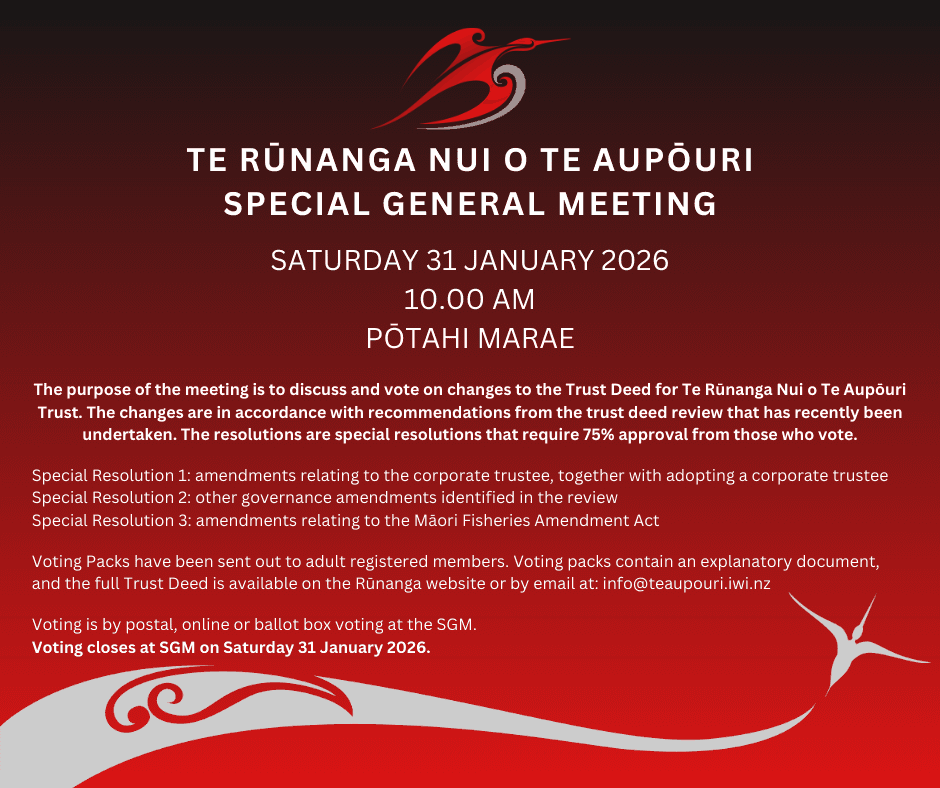
All amendments must be passed by a Special Resolution of iwi members, to be made/amended. By now, you will have received voting forms, to vote on the proposed resolutions. Voting can be completed online, via post or by in person, at the Special General Meeting (SGM), to be held on Saturday 31 January 2026, 10.00am, at Pōtahi Marae, Te Kao.
The voting process is being facilitated by Electionz. If you have not received your voting pack, or need more information on how to vote, please contact:
- Phone: 0800 EZVOTE
- Email: iroberts@electionz.com
Further information and updates will be shared via social media and emailed via the iwi register. For any other pātai, please email: info@teaupouri.iwi.nz